The Average Weight of Sunday
THIS IS A WORK OF FICTION
On the morning the first one-ton man blocked Bidhan Sarani, Calcutta behaved with its usual genius for reducing catastrophe to traffic advice.
“Take the lane behind the medicine shop,” said the tea-seller near Hatibagan, pouring liquor tea through a sieve blackened by years of honest tannin. “Ahead nothing is moving. One fat babu has fallen from ambulance.”
He said it not cruelly, but practically, the way one might say a tram had broken down, a party procession had occupied the crossing, or a marriage band had attempted democracy with tubas.
The rain had stopped ten minutes earlier. Water stood in the potholes like old tea. Above the market, torn political posters clung to damp walls, every leader smiling as if he had personally invented drainage. Delivery riders in plastic raincoats idled under a leaning signboard for a coaching center promising NEET success, JEE success, civil service success, life itself payable in installments. From the balconies of old apartment buildings, laundry hung like flags of private defeat.
Dr. Ishani Roy stepped out of the auto near the crossing with her bag held above ankle-level water. She was forty-two, a metabolic physician at North City Medical College, and carried in her face the strained dignity of a woman who had learned to be brisk because tenderness took too long. Her patients called her strict. Her colleagues called her difficult. Her mother, before dying of kidney failure in a government ward where two nurses managed forty-seven human endings, had called her “too honest for this country,” which in Bengali is not praise but diagnosis.
Ahead, the crowd thickened.
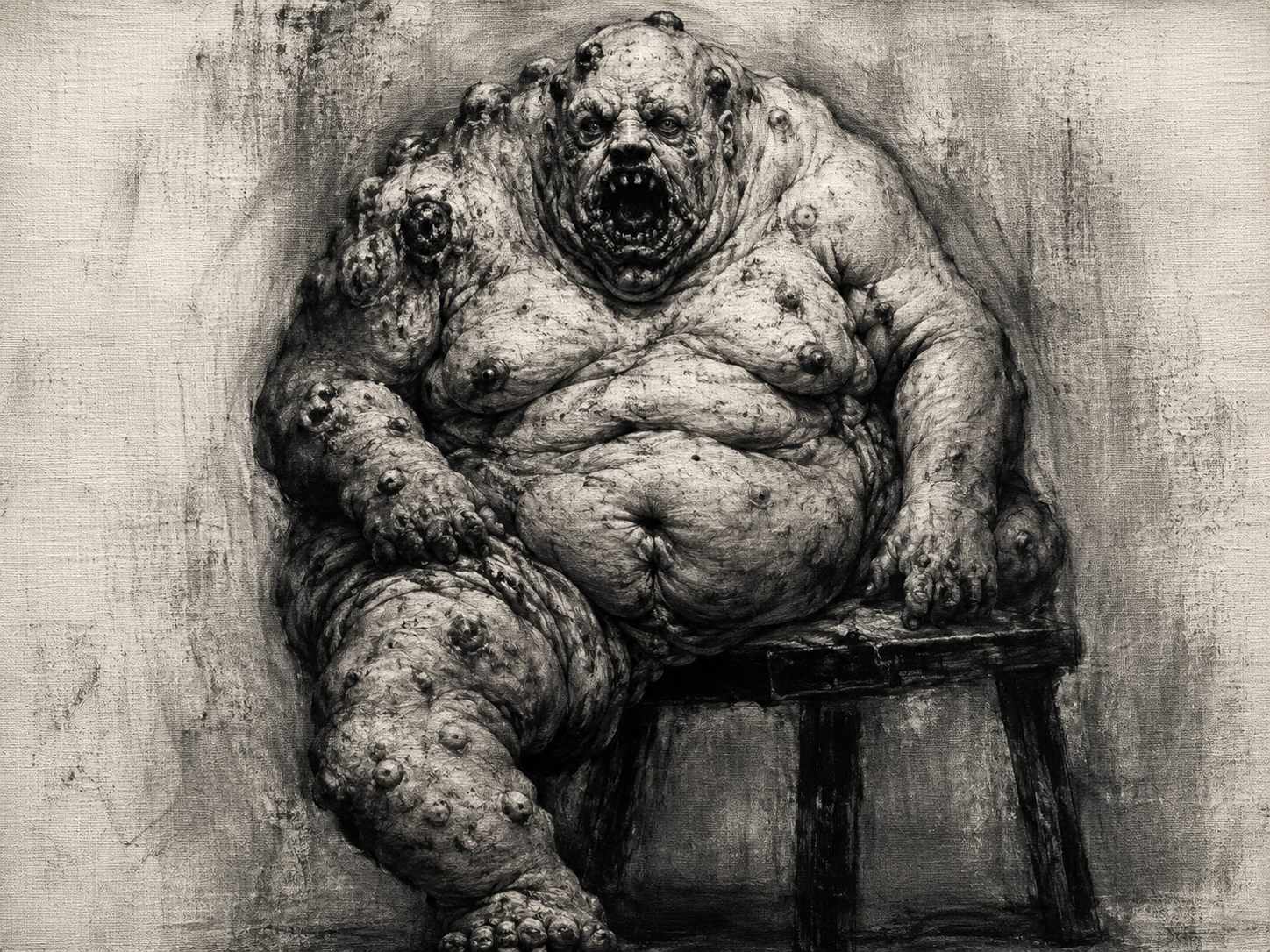
The fallen man lay half inside, half outside a private ambulance whose siren continued to bleat uselessly. His body was enormous, but not with the old arithmetic of flesh. It was not simply fat. It had lost outline. His arms had become pale cylindrical burdens, his neck a swollen collar, his belly a vast rubber hill pressing against the ambulance doors. Under the skin moved lumps, slow and private, as if bags of wet flour had been tucked beneath him by a careless god.
He was conscious.
“Water,” he whispered.
Three men tried to push him back into the ambulance and failed. A policeman shouted at the crowd. A boy filmed everything. Somewhere a woman said, “Abar video korche,” with the disgust reserved for a generation that had made tragedy vertical.
Ishani moved forward before she decided to. “Who is the doctor?”
The ambulance attendant looked relieved enough to cry. “Madam, from Dum Dum private nursing home. Bari-te couldn’t lift. Fire brigade came. Weight showing nine hundred and eighty kilo on industrial scale.”
“Nine hundred and eighty?”
“Machine maybe wrong, madam.”
But Ishani had already seen the stretcher. Its metal frame had bent into a shallow smile.
The man’s eyes found her. They were bright, frightened, almost apologetic. “I was only eighty-six last year,” he said.
By evening, he was dead.
By the following Sunday, there were twelve.
The newspapers named it Lifestyle Collapse Syndrome, because English makes panic presentable. Television channels preferred The Calcutta Weight Horror, which permitted red graphics. Doctors argued in panels. Politicians blamed imported diets, then Western decadence, then the opposition, then genes, then lack of discipline among citizens who clearly had no civic sense even in adipose tissue. A popular nutrition influencer with a beard like a TED Talk announced that the answer was millet.
The dead could not argue. They kept arriving.
At first the cases came from the predictable neighborhoods of comfort: gated towers near EM Bypass, new flats in New Town, air-conditioned offices where young men sat ten hours under blue light ordering bubble tea, peri-peri fries, cheese-loaded momos, triple-chocolate waffles, and “healthy bowls” whose sauces had the sugar content of small Diwali shops. Then came cases from old North Calcutta families, from Behala, from Garia, from Dum Dum, from families that still bought loose muri and argued over fish prices.
The commonalities were too broad to be useful. Sedentary work. Cheap sweetness. Food apps. Stress. Poor sleep. Family histories of diabetes. Power cuts. Heat. Depression. Loans. Coaching fees. Aging parents. The whole modern city, in other words.
At North City Medical College, Ishani watched the weight curve on her screen and felt the old moral tiredness settle behind her eyes.
Medicine had taught her that people enjoyed blaming bodies because it was cheaper than fixing society. A man who worked twelve hours in an accounts back office, commuted three more, lived in one damp room with his parents, and ate late because late was when he returned, was scolded for willpower by men who had drivers and cholesterol panels. Respectability in Bengal had become a performance of restraint: sugar hidden in tea, debt hidden behind curtains, sadness hidden under jokes, bodies hidden under loose shirts until they became public evidence.
Still, the numbers did not behave.
“Look,” said Rafiq.
He was not a doctor. He ran the hospital records office with the serene corruption of a man who had once wanted to be a poet and had settled for data entry. Thin, bearded, unmarried, permanently smelling faintly of cigarette smoke and cardamom, he had known Ishani since medical college days, though he had been a statistics student then, brilliant until his father’s stroke made brilliance unaffordable.
He turned his monitor toward her. “Admissions by weight band.”
“I have rounds.”
“Rounds can wait five minutes. The dead are not punctual.”
The graph rose gently for years, as expected: obesity, diabetes, fatty liver, hypertension, all the boring horsemen. Then in April, the line kinked upward. Not steeply. Obscenely. Patients crossing two hundred kilos. Three hundred. Five hundred. A cluster of eight hundred-plus in late May. No human population gained mass like that unless physics had been bribed.
“Scale errors?” Ishani said.
“Different hospitals. Different machines. Even municipal crematorium logs. The bodies are too large for standard furnaces.”
On the screen, one name made her go still.
ANANYA SEN. AGE 38. ADMISSION WEIGHT: 512 KG.
Rafiq noticed. “You know her?”
“No.”
The lie sounded small and official, like a discharge summary.
Ananya had once been Ishani’s friend, then more than friend in the unlabeled way young women sometimes become each other’s weather. They had studied together in a College Street café where the tables wobbled and ambition tasted of watery coffee. Ananya had laughed loudly, loved Rabindrasangeet without embarrassment, and believed Calcutta would change if enough good people refused to become practical.
Then Ishani married a cardiologist with a flat, a car, and the emotional availability of hospital furniture. Ananya took a job in health communications, later in marketing for NutriNest Foods, a multinational that sold “urban wellness snacks” to Indian families frightened of both hunger and fat. They drifted. Or Ishani drifted, which is how middle-class betrayal prefers to describe itself.
“Where is she?” Ishani asked.
“Isolation ward C. Your unit.”
Isolation ward C had once held dengue overflow beds. Now it held six reinforced platforms ordered from a warehouse that normally supplied steel racks to wholesale markets. The smell was antiseptic, talcum, sour sweat, and something else Ishani could not name: warm plastic left in rain.
Ananya lay under a sheet printed with blue hospital logos. Her face remained recognizable only because the eyes had refused transformation. Everything below the chin had expanded into a terrain of swollen folds and lumped masses, some soft, some hard, all gleaming faintly under stretched skin. Her hands rested on either side of her like separate animals. A catheter tube vanished under the sheet. Two ceiling fans turned above her with an insulting lack of effect.
“Ish,” she said.
Nobody had called Ishani that in twelve years.
Ishani stood beside the bed and checked the chart because charts are where doctors hide from history. “How long?”
“Three weeks. Maybe four. First I thought water retention. Then my bathroom tiles cracked.”
“Pain?”
“Not exactly. Pressure. Hunger without hunger. Like my body is eating a future version of me.”
A monitor beeped in the corner. Outside, someone’s relatives argued about visiting hours.
Ananya smiled with difficulty. “I knew you would come once I became clinically interesting.”
“That is unfair.”
“Most true things are.”
Ishani adjusted the sheet over Ananya’s shoulder. “What were you eating?”
“Everything. Nothing unusual. Office food. App food. My mother’s luchi on Sundays. Those stupid probiotic dessert cups from NutriNest.” She paused. “I helped launch them.”
Ishani looked up.
Ananya’s voice thinned. “SweetBelly Calm. Low-fat fermented dessert. Strawberry, mishti doi, salted caramel. Added fiber. Added cultures. Added nonsense. We sold it as a solution for sedentary urban digestion. For software people. Call-center people. Women at home. Schoolchildren. ‘Because modern life sits inside you.’ Remember that line?”
“No.”
“I wrote it.”
A fly struck the window glass, recovered, struck again.
“They gave free samples at offices,” Ananya said. “Hospitals too. Your diabetic camp in March had them in the gift bags.”
Ishani remembered the camp: a sponsored event under a shamiana near Shyambazar, banners fluttering, cameras flashing, poor patients receiving random glucose tests and branded advice. She had protested the sponsorship mildly, then signed the approval because the hospital needed glucometer strips and because moral purity did not buy reagents.
Ananya watched recognition enter her face.
“There,” she whispered. “Now we are both clinically interesting.”
The first biopsy came from a patient who died during intubation. The pathologist, Dr. Bhowmik, called Ishani at 2:10 a.m. His voice had the contained excitement of a man who had found a tiger in his bathroom.
“You must see this.”
The pathology lab smelled of formalin and damp paper. Rain drummed on the tin shade outside. A power cut had knocked out the main lights; the backup generator made the microscopes hum.
Under magnification, adipose tissue should have resembled bubbles. These cells looked wrong. Their membranes were thickened, elastic, almost synthetic. Between them lay translucent threads, a mesh that pulsed faintly though the sample had been removed from the body six hours earlier.
“What is that?” Ishani asked.
“Extracellular matrix behaving like hydrogel. Expands with glucose. Retains water. Also traps lipids.” Bhowmik swallowed. “But see here.”
He shifted the slide. Tiny dark granules clustered along the mesh.
“Bacteria?”
“Engineered, maybe. Some probiotic strain gone mad. They produce polymer. Like biofilm, but inside fat. In the presence of high sugar, production increases. With inactivity, lymph flow slows. Tissue becomes reservoir. Body weight increases from lipid, water, polymer. A living sponge.”
“A sponge does not become nine hundred kilos in weeks.”
“This one does, apparently. It pulls in fluid. Stimulates hunger signals. Alters leptin pathways. I am guessing. Everyone is guessing.” He rubbed his eyes. “It is not fat alone, Dr. Roy. It is architecture.”
Architecture. The word followed Ishani home.
Her apartment in Maniktala was on the third floor of a building old enough to have opinions. The lift worked when the gods were bored. On the landing, a neighbor’s pressure cooker hissed behind a closed door. Somewhere a television serial mother-in-law accused someone of betrayal with admirable lung capacity.
Ishani unlocked her flat and found three unopened food-delivery packets outside the opposite door.
Flat 3B belonged to Mr. and Mrs. Dutta, both retired, both diabetic, both lonely in the crowded way of city elders whose children lived in Bengaluru and called dutifully on video. Mrs. Dutta had started ordering desserts after her husband’s stroke because sweetness was cheaper than company. Ishani had noticed. She had said nothing. Doctors ration their concern or go mad.
From inside came a wet dragging sound.
“Dutta-mashi?” Ishani called.
No answer.
She pushed the door. It opened.
The room was dark except for the aquarium-blue light of a television showing a food app advertisement: smiling young people on a sofa, eating from boxes, their lives polished by sauces. On the bed, Mrs. Dutta lay sideways, enormous, her nightgown split at the seams. Her body had flowed against the mattress, not like flesh but like dough trapped in cloth. Lumps rose under her skin and sank again. Her mouth moved soundlessly.
On the floor beside her, Mr. Dutta’s wheelchair had tipped over. He lay beneath one of her arms, his face purple, his eyes open.
For a moment Ishani did not move.
Then she became efficient.
The ambulance arrived after forty minutes because the lane was narrow and the driver refused to enter. Fire brigade men came. Neighbors gathered. Someone mentioned karma. Someone mentioned “these people eat secretly.” Someone else asked which app she used, as if the correct brand might save them.
Mrs. Dutta died before dawn. Mr. Dutta was already dead.
At the hospital, Ishani signed forms until her fingers cramped. Rafiq found her in the records room, staring at a spreadsheet.
“You look like a ghost who has seen something worse,” he said.
“I approved the camp.”
“What?”
“NutriNest sponsored our March diabetic camp. I approved distribution.”
Rafiq sat down.
She told him about SweetBelly Calm, about Ananya, about the biopsy. He listened without interruption, which was his best quality and the reason people underestimated him.
Finally he said, “Then we need batch numbers.”
“We need proof.”
“Proof lives in inventory records. Also in lies.”
Rafiq’s talent with hospital databases had always included doors that were not officially doors. By afternoon he had obtained the distribution list from the March camp, then pharmacy logs, then municipal purchase records from school nutrition drives, then a leaked NutriNest dealer spreadsheet sent by a cousin of someone in accounts who owed him money from a Durga Puja lottery.
The pattern emerged with the elegant ugliness of a cockroach crossing white tile.
All severe cases had received SweetBelly Calm from batches manufactured after January at a contract fermentation plant outside Dankuni. Not all who consumed it fell ill. The worst cases involved high sugar intake after colonization, long sitting hours, poor sleep, and heat stress. The organism did not create the city’s habits. It weaponized them.
“This is not imported lifestyle,” Rafiq said quietly. “It is imported lifestyle plus local negligence plus corporate experiment plus our Bengali talent for adding two spoons extra sugar.”
“Not experiment,” Ishani said. “Accident.”
Rafiq looked at her. “You still want the world to be stupid instead of wicked. Very sweet.”
That evening, Ananya asked for the window blinds to be opened. Rain had washed the hospital courtyard clean in the temporary way rain lies about cities. Beyond the gate, relatives clustered with plastic bags, prescriptions, fear, and tea.
“They knew,” Ananya said.
Ishani stood beside her bed. “Who?”
“NutriNest. Not the sales people. Not me at first. The research team. The culture was licensed from a US startup making appetite-control microbiome therapy. Failed trial. Too much weight gain in animal models. NutriNest bought a modified strain for satiety desserts. Cheaper version. Local plant changed stabilizers. Sugar made it bloom.”
“Why did you not report?”
Ananya closed her eyes. “Because I found out late. Because I was scared. Because I had stock options that would not even buy a decent flat but were enough to purchase my silence for six weeks. Because my father’s bypass loan is still unpaid. Choose any ugly human reason.”
Ishani felt anger rise, then collapse. There were too many guilty people now. Guilt had become public infrastructure.
“I need documents,” she said.
Ananya laughed once, breathlessly. “Still Ish. Even in apocalypse, paperwork.”
“Where?”
“My old phone. At home. Password is your birthday.”
The room seemed to tilt.
Ananya looked at her, not kindly. “Don’t be flattered. It was the only number I never forgot.”
Ananya’s flat was in a new tower near Lake Town, with a lobby smelling of artificial jasmine and financial aspiration. The guard tried to stop Ishani until she used the voice doctors reserve for relatives and bureaucrats. Upstairs, the corridor lights flickered. A delivery rider waited outside another flat holding six tubs of biryani and a paper bag from a dessert chain, his phone buzzing like an insect.
Inside, Ananya’s apartment was neat in the manner of people who are losing control elsewhere. Books. A treadmill used for hanging clothes. Fridge magnets from conferences in Singapore and Dubai. On the dining table sat three empty SweetBelly cups, washed and stacked.
Ishani found the phone in a drawer.
The files were worse than confession. Emails. Trial notes. Internal warnings. Photographs of lab rats ballooned into obscene pale shapes. A memo describing “rare runaway adipose-polymer expansion under high glucose conditions.” A marketing deck recommending launch in “high-growth sedentary urban markets with strong dessert culture.”
Under dessert culture, someone had placed a stock photograph of a Bengali family eating mishti.
Ishani sent everything to Rafiq, to Bhowmik, to two journalists she distrusted less than others, and to a lawyer who owed her because she had once diagnosed his son’s Type 1 diabetes when three doctors had called it exam stress.
Then her phone rang.
Rafiq.
“Ishani,” he said, and the absence of wit in his voice frightened her. “Do not come back through Ultadanga. Roads blocked. Cases everywhere. People are swelling in homes. Police are sealing stores. There is a rumor the hospital hid it.”
“Did they?”
“Yes. But that is not the point right now.”
Outside the tower window, the city had begun making a new sound. Not sirens exactly. Not shouting. A low collective panic, spreading lane by lane. In the distance, above tram wires and wet rooftops, puja lights from an unfinished pandal blinked red, blue, red, blue, cheerful as a machine with no conscience.
By midnight, Calcutta’s appetites turned against it.
Bodies expanded in bedrooms, in office chairs, in taxis, in cheap cafés where young men had spent evenings stretching one cold coffee into civilization. Lifts jammed under impossible weight. Staircases cracked. Hospital floors were reinforced with bamboo and prayer. Families argued outside wards, blaming wives, husbands, mothers, children, food, genes, fate, America, Bengal, God, government, capitalism, and finally doctors, who were available.
Yet the strangest thing was not the size.
It was the shape.
The patients did not merely grow. They lost human borders. Faces sank into swelling cheeks. Fingers became little blunt paddles. Bellies spread sideways, downward, outward, adjusting to rooms like water obeying a container. The lumps under the skin multiplied, each one a pocket of polymer and fluid, a private warehouse of modernity. Some patients became half a ton. Some crossed a ton. In the worst wards, language failed and staff began referring to beds by weight, not name.
Five hundred in C.
Seven hundred in D.
Nine-fifty gone.
Ananya survived three more days.
On the last afternoon, when the power failed and the backup took thirty long seconds to catch, Ishani sat beside her with a hand on the sheet. In the dark, the ward breathed.
“Will they arrest me?” Ananya asked.
“Yes.”
“Good.”
“That will not fix anything.”
“No. But Bengalis need at least one person to blame before dinner.” Her eyes shifted toward Ishani. “You too.”
Ishani did not answer.
Ananya’s voice became smaller. “Did you ever love me?”
The question arrived obscenely late, like a bill after the funeral.
“Yes,” Ishani said.
“Then why did you choose him?”
Because he was acceptable. Because he had a car. Because women like Ishani were allowed ambition only if they attached it to a respectable man. Because desire without a certificate was treated as a fever. Because Calcutta could forgive corruption, cruelty, and incompetence, but not a woman who wanted incorrectly.
“I was afraid,” she said.
Ananya looked satisfied, though not comforted. “Finally. A clean diagnosis.”
She died at 6:17 p.m., during rainfall so heavy the hospital courtyard disappeared.
The documents exploded across the country. NutriNest denied, then regretted, then suspended, then promised cooperation. Ministers ordered inquiries. Experts appeared nightly in rectangles. Shops burned in three neighborhoods. In one viral clip, a man smashed a dessert freezer with a cricket bat while shouting that foreign bacteria had ruined Bengali civilization, standing under a sign advertising imported whey protein.
The organism was named Calcutta adipopolymeric syndrome, though everyone called it Rubber Flesh.
Containment came slowly. Antibiotics helped if given early. Sugar restriction slowed progression. Movement helped before the polymer set. Heat worsened everything. The city, which had spent years building lives around sitting, ordering, scrolling, commuting, waiting, and swallowing sweetness as consolation, was instructed to walk.
People laughed bitterly at that.
Where? On which pavement? Between which hawker stall and which open drain? After which twelve-hour shift? With which safe park? Under which breathable sky?
Still, they walked.
For weeks, Calcutta became a city of frightened pedestrians. Office workers marched in circles under flyovers. Grandmothers shuffled on balconies. Children were made to climb stairs. Men who had not moved except to find the remote now circled para lanes under the surveillance of gossiping aunties, the most powerful public health system in eastern India.
By August, new cases declined.
By September, Ishani had become famous in the reluctant way useful women become famous: too late, too burdened, and with everyone asking why she had not acted sooner. Rafiq said fame suited her like a borrowed sari. Bhowmik received a research grant. NutriNest executives vanished into legal fog. Ananya became a headline, then a symbol, then a photograph used by both activists and trolls, which is the modern sequence of dying twice.
The hospital built a specialized bariatric isolation unit with reinforced floors. Above the entrance, a banner announced a government initiative for Lifestyle Resilience.
One evening in October, Ishani stayed late reviewing follow-up scans. The monsoon had retreated, leaving dampness behind like an unpaid debt. Outside her office window, metro announcements floated up from the station, blurred by traffic. Somewhere nearby, someone was frying telebhaja in old oil. Life, vulgar and undefeated, resumed.
Rafiq entered without knocking. He held a file.
“You need to see this.”
“No.”
“Yes.”
He placed the file on her desk. New municipal survey. Random sampling across wards. Weight, blood sugar, stool cultures, household food patterns.
Ishani read the first page. Then the second.
“The average weight is still rising,” Rafiq said.
“That is impossible. New cases are down.”
“Severe cases. Deaths. Hospital admissions. Those are down.” He tapped the graph. “But colonization is spreading silently. Low-level polymer production. Five kilos here. Twelve there. Children too. Not enough to panic. Enough to shift the baseline.”
Ishani stared at the line. It climbed gently, politely, like a guest removing shoes before entering.
“How many colonized?”
“Forty-three percent in sampled wards.”
“No.”
“Higher in households where nobody ate SweetBelly directly.”
She looked up.
Rafiq’s face had gone gray. “It is transmitting. Not efficiently, but enough. Shared bathrooms. Drains. Maybe water tanks. Maybe touch. Maybe the city itself is a culture medium.”
The old building groaned in the evening heat. Downstairs, relatives shouted near billing. A child laughed. A trolley squeaked. Somewhere, tea was being stirred with too much sugar because grief, fatigue, and habit do not read advisories.
Ishani turned back to the survey.
At the bottom of the page was a projection model, cautious and bureaucratic, its language scrubbed clean of terror. If current trends continued, adult mean body weight in metropolitan Kolkata would cross 180 kilograms within five years. In extreme heat, with food insecurity and high-sugar substitution, runaway polymeric gain could normalize weights previously considered catastrophic. Half-ton bodies would no longer be rare. One ton would become a foreseeable medical category.
Not apocalypse. Worse.
Administration.
Her phone buzzed. A food app notification lit the screen.
RAINY EVENING COMFORT DEALS. ORDER SWEET. FEEL HUMAN.
Ishani watched the words glow in her palm. Then, from the ward below, came the soft, unmistakable sound of reinforced metal bending.